

Trust Your Data Before You Trust Your AI
- Tracey Gatlin

- 1 day ago
- 4 min read
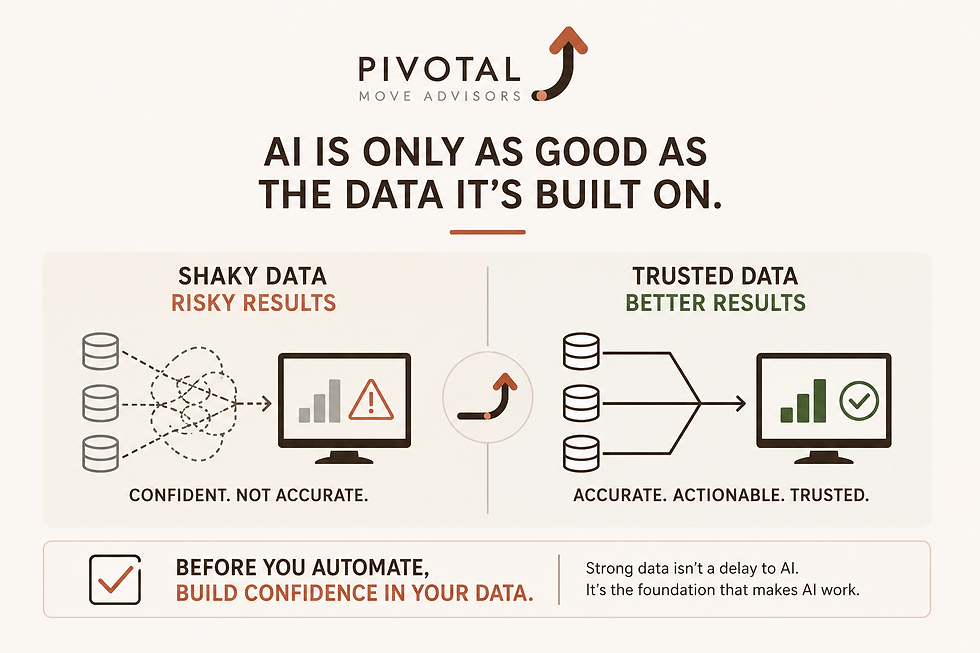
I was on a call not long ago with an operations leader who wanted to talk about AI. Twenty minutes in, I asked her a simple question: how confident was she in the data three of her core systems were feeding each other. She paused longer than she meant to. "Honestly? Not very."
Then she laughed, a little uncomfortably, and said she'd rather not think too hard about it.
That pause told me more than the AI conversation did. And it's not just her. A recent industry survey of mobility and operations leaders found that only about half trust the accuracy of their own data, and less than half trust the platforms that data lives in. Those are the same leaders under real pressure to roll out AI faster.
Here's the part worth sitting with. AI doesn't fix a data problem. It amplifies it.
The Order Everyone Gets Backward
The instinct, understandably, is to treat AI as the fix. Reports are slow, forecasts are unreliable, and someone in the room says "we should just use AI for that." It sounds like progress. It's usually the wrong order of operations.
AI doesn't know your inventory count is three weeks stale. It doesn't know two systems are using different definitions of "active vendor." It doesn't know a spreadsheet somewhere has a formula error nobody's caught since 2022. It just takes whatever it's given and produces something confident-sounding on the other end. Confidence and accuracy are not the same thing, and AI is very good at the first one regardless of the second.
Organizations with high trust in their own data are, by every measure I've seen, dramatically less likely to run into real implementation barriers when they adopt AI. Not because their AI is smarter. Because their inputs are worth trusting in the first place.
What This Looks Like Up Close
Picture two companies rolling out the same AI tool for demand forecasting.
The first has three years of sales data spread across a CRM, a spreadsheet someone maintains by hand, and an ERP system that doesn't quite talk to either. Nobody's reconciled the three in a while. They plug the AI tool in, and it produces a forecast. It looks clean. It looks authoritative. It's wrong in ways nobody catches for two quarters, because the tool has no way of knowing the CRM numbers were double-counting a chunk of renewals.
The second company spends six weeks first doing not such glamorous work, just reconciling the same three sources, agreeing on one definition of each metric, and fixing the handful of things that had quietly drifted out of sync. Then they plug in the same tool. The forecast isn't necessarily flashier. It's right, and when it's off, they can trace exactly why, because they understand what's feeding it.
Same tool. Same budget, roughly. Completely different outcome, because one company did the unglamorous work first and the other one didn't.
Why This Keeps Happening
Part of it is timing pressure. Boards want AI progress on a timeline that doesn't leave room for six weeks of data reconciliation, so teams skip straight to the tool. Part of it is that data cleanup is invisible work. Nobody gets credit in a quarterly review for having fixed a definition mismatch.
Everybody notices a shiny new dashboard.
And part of it is that admitting the data's shaky feels like admitting the operation isn't as buttoned-up as it looks from the outside. That's a hard thing to say out loud in a room full of people who are counting on you to have it handled. But the leaders who say it anyway are the ones whose AI rollouts work.
What Actually Helps
Audit before you automate. Before any AI tool goes live, know where its inputs come from and how confident you are in each one, not on faith. A real, honest look.
Pick one source of truth per metric. If three systems each have a version of "active customer count," decide which one is authoritative and reconcile the others to it. AI can't do this step for you. It just inherits whichever version it's handed.
Treat data cleanup as part of the AI budget, not a delay to it. The six weeks a team spends reconciling data isn't time lost before the real work starts. It is the real work. Budget for it up front instead of discovering it later as a crisis.
Ask the uncomfortable question in the room, out loud. "How sure are we of this number?" is worth asking before every AI rollout, not after the first bad forecast makes it unavoidable.
None of this slows AI down in any way that matters. It's the difference between AI that's useful and AI that's just producing confident-sounding noise faster than a person could.
The Takeaway
AI doesn't upgrade a shaky foundation. It just builds on top of it, faster and with more confidence than the foundation deserves. The leaders getting real value out of AI right now aren't the ones who moved fastest. They're the ones who did the unglamorous work of trusting their data first.
Worth sitting with: before your next AI conversation, ask the question that operations leader almost didn't answer out loud. How confident are you, on a scale that would hold up under scrutiny, in the numbers everything else is about to be built on.


Comments